Should I Hire an Independent Contractor or a Big Box Store?
Home Depot and Lowe's vs. an independent flooring contractor — who actually shows up, who you call when something goes wrong, and which one is actually cheaper after the change orders land.
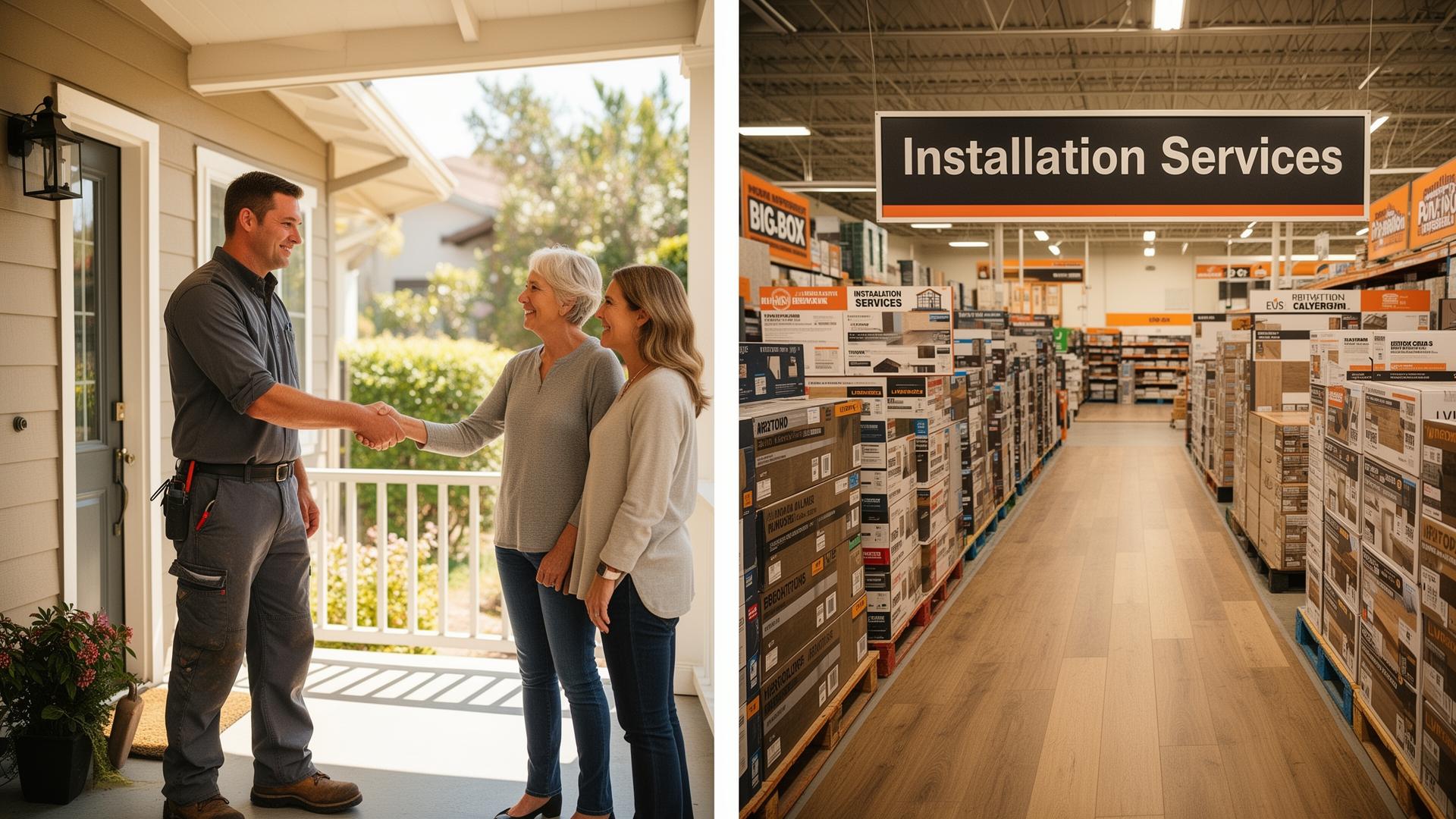
You''ve picked your flooring. Now you have to decide who installs it. The two paths most homeowners weigh are the "installation included" service at a big box store (Home Depot, Lowe''s, Costco) or an independent local flooring contractor. The labor on the floor is often equally skilled — the real differences are everything around it: who signs the contract, how change orders are priced, how fast you can start, and who picks up the phone when something goes sideways three weeks later.
Who actually shows up to install your floor?
Here''s the part most homeowners don''t realize: big box "installation included" is almost always subcontracted. The store is the middleman. They sell you the package, take payment, and dispatch an independent crew managed through their installation program. You don''t get to pick which crew. You don''t meet them until install day. If you don''t click with them, your only lever is to call the store.
An independent contractor is a direct hire. The person who measured your floor is usually the person on-site or the one supervising the crew. The name on the truck is the name on the contract. If something''s off, there''s no escalation tree — you call them.
Neither model guarantees a better installer. We''ve seen excellent big-box subs and mediocre independents (and vice versa). What changes is who''s accountable when things drift.
The two paths, side by side
| What matters | Big box store | Independent contractor |
|---|---|---|
| Who you sign with | The retail store | The installer / owner |
| Who installs | Third-party sub (assigned, not chosen) | The contractor''s own crew |
| Material flexibility | Usually must buy from that store | Source anywhere — store, online, or supplied |
| Scope flexibility | Packaged scopes; harder to customize | Line-item — skip or add what you want |
| Change-order pricing | Set by store schedule; often above market | Negotiated up front, ideally printed |
| Scheduling lead time | 2–6 weeks (queue + assignment) | Often 1–2 weeks for smaller jobs |
| Warranty handler | Store, then sub — two-step claim | Same person who installed it |
| Communication mid-job | Call center / project coordinator | Direct text/call with the installer |
| If something goes wrong | File a claim, wait for re-dispatch | Installer comes back to fix it |
Where the big box wins
It''s not all downside. Big box stores genuinely have advantages worth naming:
- Bundled financing. Store credit cards offer 0% promotional periods (typically 12–24 months) on installation packages. An independent usually can''t match that.
- One-stop convenience. Material, install, financing, and warranty are all in one transaction. You don''t coordinate anything.
- Brand recognition. If you''ve had a bad experience with contractors before, the comfort of a national name is real. There''s a corporate complaint channel.
- Sometimes a lower advertised labor rate. Headline rates like "$2.49/sq ft installation" can beat independents — until you read the exclusions (more on that below).
Where an independent wins
For most homeowners doing a single project, an independent contractor is the better fit for these reasons:
- Same person from quote to warranty. The estimator, the installer, and the person who answers your call in six months is the same business. No re-explaining your job to a stranger.
- Itemized, transparent pricing. A good independent gives you a quote that reads like a list: removal $X, prep $Y, install $Z, baseboards $W. You see exactly what you''re paying for. (At TRU, this is non-negotiable — see our price list.)
- Material flexibility. Buy your LVP at a big box, online, or from a local distributor — the installer just installs it. You''re not locked into one retailer''s catalog or markup.
- Scope flexibility. Want to do your own demo? Skip baseboard replacement? Add stairs mid-job? An independent will quote it line by line. A big-box package is usually take-it-or-leave-it.
- Faster scheduling. Small and mid-size jobs that sit in a big-box queue for weeks can often start within days with an independent.
- Accountability for the punch list. When you find a creaky board or a gap at a transition three weeks later, an independent comes back. With a big box, you file a claim and wait for re-dispatch.
The total-cost trap
This is the part that catches most homeowners off guard. Big-box install quotes often look cheaper per square foot than independents — until the change orders hit. The headline rate frequently excludes:
- Furniture moving (sometimes anything over a certain weight)
- Removal of existing flooring beyond a basic carpet pull
- Subfloor prep beyond a quick sweep — leveling, patching, screw-down
- Transition strips and thresholds between rooms
- Stairs (almost always priced separately, often steeply)
- Baseboard or quarter-round replacement
- Haul-away of old material
Each of these shows up as a change order on install day, priced from the store''s schedule. By the time the job is done, the "$2.49/sq ft" number is closer to $5–7/sq ft all-in — and often higher than the independent quote that looked more expensive up front because it itemized everything from the start.
The fix: make every quote apples-to-apples. List every task you need done — removal, prep, install, transitions, baseboards, stairs, haul-away — and ask each bidder to price each line. Then compare totals, not headline rates. Our guide on getting multiple flooring quotes walks through the format.
A 5-question test for either option
Whether you''re leaning big box or independent, ask the same five questions before signing:
- Is the labor warranty in writing, and for how long? One year is the floor; two or more is better.
- Who exactly signs the contract — and who installs? If those are different parties, what''s the escalation path?
- Who do I call mid-job if there''s a problem at 8 a.m. on a Tuesday? Get a direct number, not a call center.
- Are change-order rates printed in advance? If a discovered issue adds work, you should know the per-unit cost before they start.
- Can I see references from jobs completed in the last 90 days? Old reviews don''t tell you who''s on the truck this month.
For a deeper vetting checklist, see 18 questions to ask a flooring contractor before you sign and what makes a good LVP installer.
How TRU handles this
We''re an independent flooring contractor serving Los Angeles and Ventura Counties. Our model is the opposite of the big-box pattern: the person who measures your floor is the person responsible for it. You sign with us, our crew installs, and if anything''s off in year one, the same number you have on day one is the number that answers in month eleven.
Pricing is published — every line item is on our price list, and you can build a labor estimate in seconds with our instant calculator before you ever speak to us. When you''re ready for a real quote on your home, book a measurement visit and we''ll come out, measure precisely, and send an itemized quote. No mystery line items, no install-day surprises.
For a sibling comparison on where to buy the flooring itself, see local flooring store vs. big box for LVP. For what should already be in a complete install scope, see what a professional flooring installation includes.
Know your flooring cost in 60 seconds.
Use our published rates to get an itemized estimate — no phone calls, no sales pressure.
Keep reading
All articles →
How to Spot a Red Flag When Hiring a Flooring Contractor
Most bad flooring jobs are predictable from the first phone call. Here are the 12 biggest warning signs to watch for — grouped into credentials, the quote, the contract, and the deposit — plus a 10-minute vetting checklist.
What Warranty Should Come With Professional LVP Installation?
Every pro LVP install should come with two warranties — the manufacturer's product warranty and the installer's workmanship guarantee. Here's what each should cover, what shouldn't, and the red flags to watch for before you sign.