What Warranty Should Come With Professional LVP Installation?
Every pro LVP install should come with two warranties — the manufacturer's product warranty and the installer's workmanship guarantee. Here's what each should cover, what shouldn't, and the red flags to watch for before you sign.
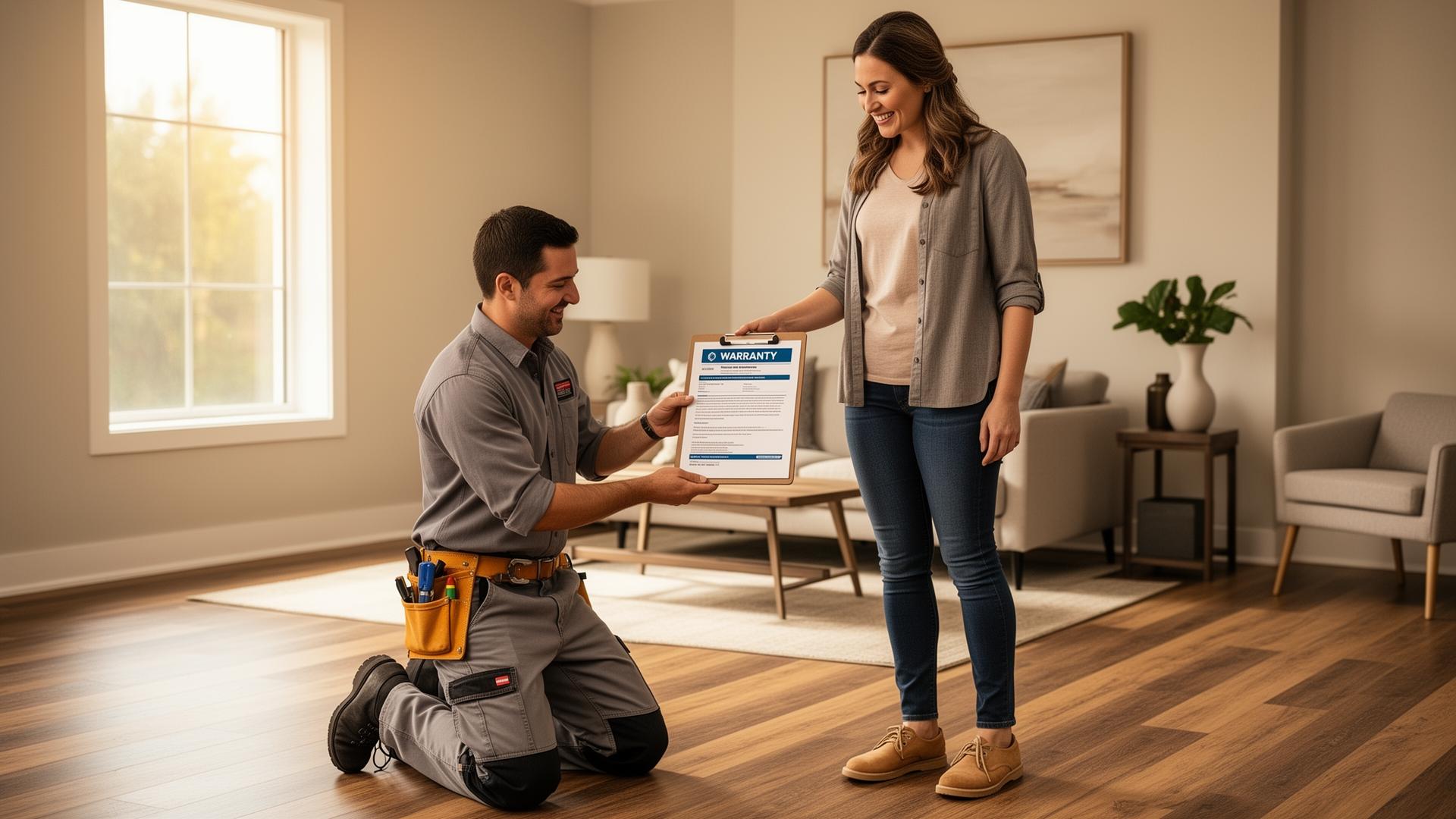
Short answer: A professional LVP installation should come with two separate warranties — the manufacturer''s product warranty (covers the planks themselves, typically 15–25 years residential) and the installer''s workmanship warranty (covers the labor, typically 1–5 years). Most homeowners only think about the first one. The second is where you get burned. If your installer won''t put a workmanship warranty in writing, walk away.
Manufacturer warranty: what it actually covers
The manufacturer warranty is printed on the box and lives on the brand''s website. It covers product defects — problems with the plank itself, not how it was installed.
Typical covered failures:
- Delamination — wear layer separating from the core
- Wear-layer failure — premature wear-through under normal use
- Excessive color fading beyond the rated UV tolerance
- Core swelling or warping on waterproof-rated SPC products
- Manufacturing defects in click joints or surface finish
Coverage tiers you''ll see in spec sheets: residential 15–25 years, light commercial 5–10 years, heavy commercial 3–5 years. The big number on the box is almost always the residential figure, and it''s usually prorated after the first few years — meaning year-15 coverage may only refund 20% of the original product cost.
The catch homeowners miss: the manufacturer warranty requires the floor to have been installed to spec. That means proper acclimation, an approved underlayment, the right expansion gap, and a subfloor that meets the flatness tolerance (see how pros ensure planks are level). If any of those are off, the manufacturer denies the claim and points at the installer. This is exactly why subfloor prep matters so much — it''s also what keeps your product warranty intact.
Workmanship warranty: the one that matters most
This is the warranty from the installer that covers their labor. It''s what protects you when the floor itself is fine but the install was wrong. The manufacturer won''t pay to fix a botched install — only the installer will, and only if they offered you a workmanship warranty in writing.
What a real workmanship warranty should cover
- Seam gaps and peaking caused by improper acclimation, inadequate expansion gap, or wrong-direction install
- Telegraphing from debris, fasteners, or seams left on the subfloor before install
- Hollow spots from skipped or inadequate subfloor leveling
- Plank movement beyond manufacturer-allowed expansion
- Adhesive failure on glue-down installs
- Damage to baseboards, transitions, or trim during install
- Squeaks caused by skipped subfloor screws or loose underlayment
What''s a normal duration?
- Less than 1 year — red flag, walk away
- 1 year — the minimum any pro should offer
- 2–3 years — standard for reputable independent installers
- 5 years — premium, common from well-established companies that document subfloor conditions and use written contracts
- "Lifetime" — usually marketing copy with limits buried in the fine print; ask exactly what''s covered, by whom, and for how long
What to demand in writing
- Scope — exactly which failure modes are covered
- Duration — start date and end date in years
- Exclusions — what they will not cover
- Response time — how fast they''ll come out for a callback (industry standard is 7–14 days)
- Remedy — whether they repair only, or also cover removal and reinstall of affected planks
- Materials — who pays for replacement planks if the originals are damaged in repair
Red flags
- "We stand behind our work" with nothing on paper
- "Lifetime" warranty from a brand-new or one-person operation
- Warranty shorter than 12 months
- Warranty that excludes everything that could actually go wrong (e.g., excludes "subfloor-related issues" when the installer was the one who prepped the subfloor)

What''s usually NOT covered (and why)
No warranty — manufacturer or workmanship — covers what the trade calls "household incidents." If the floor failed because of something that happened in your home, you''re on the hook.
- Normal wear and tear — scuffing, micro-scratches, dulling in traffic lanes
- Pet and furniture damage — claw scratches, dent from a dropped tool, dragged appliance
- Water damage from leaks or floods — even "waterproof" LVP only resists topical water; standing water from a dishwasher leak that wicks under planks isn''t covered
- UV fading without window treatments — manufacturers exclude direct sun damage beyond rated tolerance
- Wrong cleaning products — steam mops, oil soaps, and abrasive cleaners void most warranties
- Pre-existing subfloor issues the installer documented and you declined to have corrected
The line is simple: install defect = installer''s problem. Product defect = manufacturer''s problem. Household incident = your problem.
How to verify a warranty before you sign
- Ask for the warranty document before the contract — not after. A real workmanship warranty is a one-page PDF the installer can email you the same day.
- Check how long the company has been in business. A 5-year warranty from a company that''s been operating for 8 months is worth less than a 1-year warranty from a company with a 15-year track record.
- Verify the license and insurance. In California, flooring installers should hold a C-15 (Flooring & Floor Covering) contractor''s license and carry general liability. An uninsured installer can''t honor a warranty if they go out of business.
- Ask for callback examples. Any honest installer will tell you about a recent callback and what they did to fix it. "We''ve never had a callback" is a sales line, not a fact.
- Confirm transferability. Some workmanship warranties transfer to the next homeowner, which adds resale value. Most manufacturer warranties do not transfer.
- Read the subfloor clause. Reputable installers document the subfloor condition before install (photos and a written assessment). That protects both sides — you get a warranty that can''t be voided with "it must have been the subfloor," and they''re protected from claims about issues that existed before they started. We do this on every TRU job.
What a callback costs if you''re not covered
If a non-warranty install goes wrong, you''re paying out of pocket. Realistic repair costs in 2026:
- Spot repair (a few planks) — $200–$500 minimum trip charge, more if planks need to be ordered
- Partial tear-out and reinstall — $4–$7 per square foot, plus new material if your style is discontinued
- Full room redo — $6–$10 per square foot all-in, similar to a fresh install
- Discontinued plank matching — sometimes impossible; you redo the entire room to avoid a mismatched patch
For a 500 sq ft living room, a full redo can run $3,000–$5,000. A 2-year workmanship warranty makes that someone else''s problem.
The TRU Installation warranty
We''re upfront about every line on the invoice — including the warranty. Every TRU LVP install includes a written workmanship warranty, a documented subfloor assessment, and follow-up after install so small things get fixed before they become big things. Combine that with the published manufacturer warranty on whichever plank you choose, and you have real coverage on both the product and the labor.
Use our transparent price list to get an itemized estimate in 60 seconds, or book a measurement and we''ll walk through both warranties with you on-site — in writing, before any contract is signed. While you''re comparing options, our guides on what should be in an LVP quote, how to compare quotes side by side, and the most common LVP install mistakes will save you from the most expensive surprises.
The right warranty doesn''t just protect the floor. It tells you the installer expects to still be in business when you call them in three years.
Know your flooring cost in 60 seconds.
Use our published rates to get an itemized estimate — no phone calls, no sales pressure.
Keep reading
All articles →
How to Spot a Red Flag When Hiring a Flooring Contractor
Most bad flooring jobs are predictable from the first phone call. Here are the 12 biggest warning signs to watch for — grouped into credentials, the quote, the contract, and the deposit — plus a 10-minute vetting checklist.
Should I Hire an Independent Contractor or a Big Box Store?
Home Depot and Lowe's vs. an independent flooring contractor — who actually shows up, who you call when something goes wrong, and which one is actually cheaper after the change orders land.