How to Spot a Red Flag When Hiring a Flooring Contractor
Most bad flooring jobs are predictable from the first phone call. Here are the 12 biggest warning signs to watch for — grouped into credentials, the quote, the contract, and the deposit — plus a 10-minute vetting checklist.

Short answer: Most bad flooring jobs are predictable from the first phone call. The warning signs cluster into four areas — credentials, the quote, the contract, and the deposit. One red flag deserves a question. Two or more and you keep looking. This guide is the 10-minute filter we wish every homeowner ran before signing.
Category 1: Credential red flags
Before anyone walks into your home with a tear-out bar, they should pass a basic credential check. This is the single fastest way to filter out the worst offenders.
1. No active California contractor''s license
In California, any flooring job over $500 (labor + materials) legally requires a licensed contractor. Flooring installers should hold a C-15 Flooring & Floor Covering license from the Contractors State License Board (CSLB). Verify the number at cslb.ca.gov — license search is free and takes 30 seconds. Check that it''s active, not expired, not suspended, and that the name on the license matches the name on the quote.
2. No general liability or workers'' comp insurance
If an uninsured worker is hurt in your home, you may be financially liable. If an uninsured contractor damages your subfloor, plumbing, or HVAC during install, you''re paying for the fix. Ask for a current Certificate of Insurance (COI) emailed directly from their insurer — not a photo of an old printout.
3. No verifiable business address
A cell number, a P.O. box, and a free Gmail address with no street address is the profile of a contractor who can disappear overnight. Legitimate businesses have a registered address, a business email on a real domain, and a footprint you can verify (Google Business listing, BBB profile, even a Yelp page).
4. A review profile that doesn''t add up
Only 5-star reviews, all posted in the same week, all with stock-photo profile pictures — that''s a fake review farm. The opposite extreme — zero reviews on a "10-year established business" — is also a warning sign. Healthy review profiles have a mix of ratings spanning years and detail-specific feedback about actual jobs.
Category 2: Quote red flags
5. Verbal quote with no itemized PDF
"I''ll do the whole thing for $4,500" is not a quote. A real estimate breaks out material, labor per service, removal, baseboards, prep, and any add-ons as separate lines you can compare against other bids. Our guide on what should be in an LVP quote covers every line item that should appear.
6. A bid that''s dramatically lower than every other bid
If three contractors quote $5,800, $6,200, and $6,400 — and one quotes $3,400 — the outlier is hiding something. Usually it''s skipped subfloor prep, no underlayment, no removal, no transitions, or labor performed by uninsured subcontractors paid in cash. The "deal" turns into a change-order war once they''re in your house. Compare bids properly with our side-by-side comparison guide.
7. Square-footage allowance with no waste factor
A real estimate adds 7–10% to your measured square footage for cuts, pattern matching, and future repairs. A quote that uses your raw measurement is either rounding the math in their favor or planning to charge you for the missing material as a change order.
8. "Prep is included" with no specifics
Prep is the single most important line on the invoice (see why subfloor prep matters). A quote that says "prep included" with no description of what prep — patching, leveling, screw sweeping, moisture testing — is a quote that doesn''t include prep and will bill you for it later.

Category 3: Contract and process red flags
9. No written contract — or a generic one-pager
California law requires home improvement contracts over $500 to be in writing and to include specific elements: a description of the work, total price, start and substantial completion dates, deposit terms, the contractor''s license number, and the three-day right of rescission. A handshake deal isn''t just risky — it''s non-compliant.
10. No workmanship warranty in writing
"We stand behind our work" is a sales line. A real workmanship warranty is a written document specifying scope, duration, exclusions, and callback response time. Our full breakdown is in what warranty should come with professional LVP installation. If a contractor won''t put their warranty on paper, they don''t actually have one.
11. Won''t do an in-home measurement
Anyone who quotes a final price from a phone photo and a rough room dimension is guessing. In-home measurement catches subfloor surprises (cracks, soft spots, height differences at thresholds), confirms the actual square footage, and is the moment a real installer documents pre-existing conditions to protect both sides. Skipping it almost guarantees a change order. The classic install mistakes that follow are covered in the most common LVP installation mistakes.
12. Pressure to decide today
"This price is only good if you sign tonight" is a high-pressure sales tactic, not a business reality. Material prices don''t move that fast, and labor schedules can wait a day. Anyone forcing a same-day decision is preventing you from running the rest of this checklist — which is exactly why they''re doing it.
Category 4: Payment red flags
Cash-only or oversized deposits
California caps residential home improvement deposits at 10% of the contract price or $1,000, whichever is less. A contractor asking for 50% upfront — or "just the cost of materials, in cash, today" — is asking you to fund their next job (or to disappear with your money). Both are illegal under CA Business & Professions Code §7159.5.
Payment to a personal Venmo or Zelle
A legitimate business has a business bank account, accepts checks made to the company name, and ideally takes card payments. Requests to pay a personal name on a peer-to-peer app are a sign you''re not dealing with a real business — and you''ll have no recourse if the work fails.
Full payment before work starts
Standard practice is a small deposit (within the legal cap), progress payments as milestones are hit, and a final payment after walkthrough and acceptance. Full payment upfront removes every incentive to come back and fix anything.
The 10-minute vetting checklist
Before you sign any contract:
- CSLB lookup — confirm the C-15 license is active and matches the business name (cslb.ca.gov, 30 seconds)
- Insurance certificate — request a current COI emailed by the insurer, not the contractor
- Cross-check reviews — Google, Yelp, and BBB; look for spread over time and specific job details
- Two recent references with phone numbers — and actually call them
- Written warranty document — request it before signing the contract
- Itemized written quote — every line broken out, with prep specifics
- Deposit at or below the legal cap — 10% or $1,000, whichever is less
Ten minutes of vetting prevents months of repair calls. If a contractor pushes back on any of these requests, that''s your answer.
How TRU is set up to pass every check
We publish our rates so there''s nothing to hide. Our transparent price list shows exactly what each service costs, and our in-home measurement includes a written subfloor assessment, an itemized PDF quote, and our written workmanship warranty — all reviewed with you before any signature. If you''re comparing us against other bidders, the guide on independent contractors vs big-box stores is a useful starting point.
The single most expensive flooring decision isn''t which plank you picked — it''s which installer you trusted with it. Run the checklist.
Know your flooring cost in 60 seconds.
Use our published rates to get an itemized estimate — no phone calls, no sales pressure.
Keep reading
All articles →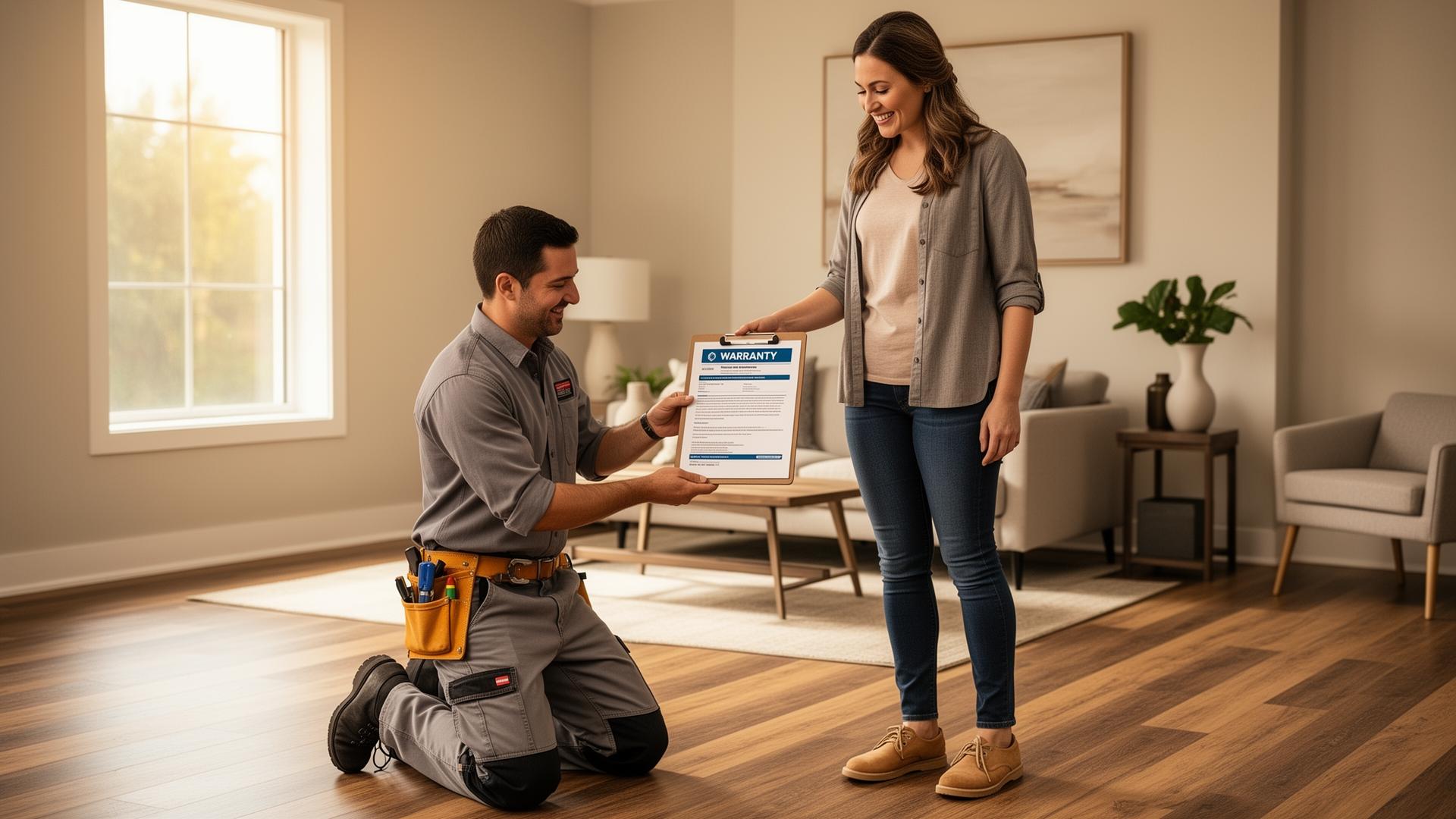
What Warranty Should Come With Professional LVP Installation?
Every pro LVP install should come with two warranties — the manufacturer's product warranty and the installer's workmanship guarantee. Here's what each should cover, what shouldn't, and the red flags to watch for before you sign.
Should I Hire an Independent Contractor or a Big Box Store?
Home Depot and Lowe's vs. an independent flooring contractor — who actually shows up, who you call when something goes wrong, and which one is actually cheaper after the change orders land.