Local Flooring Store vs Big Box Retailer: Where Should I Buy LVP? (2026 Buyer's Guide)
Should you buy luxury vinyl plank at Home Depot, Floor & Decor, or a local flooring store? A Southern California installer breaks down the real price, quality, dye-lot, and warranty trade-offs.
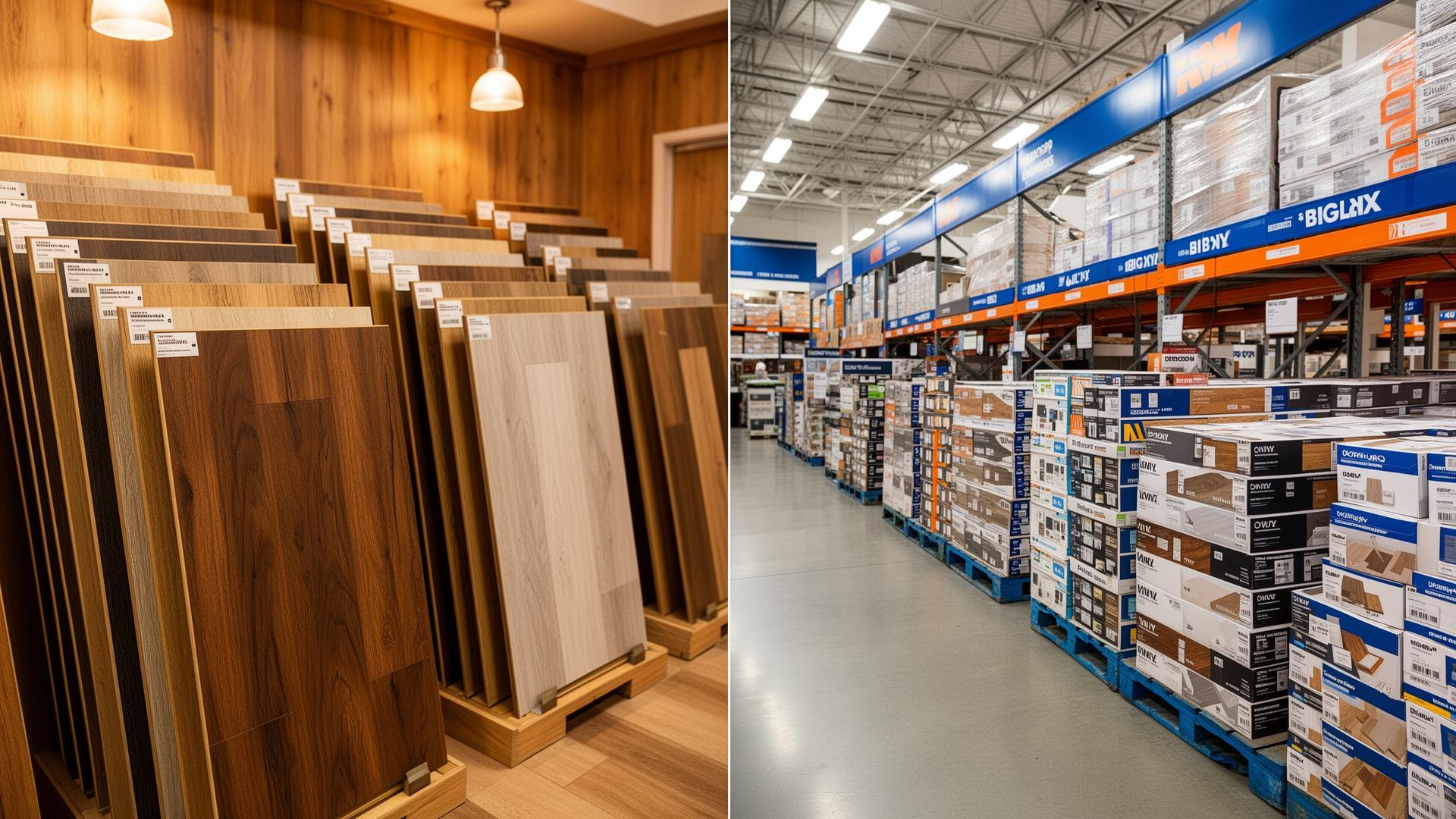
Short answer: Big-box stores (Home Depot, Lowe's, Floor & Decor) win on sticker price and instant pickup for builder-grade LVP. Local flooring stores win on plank quality, dye-lot consistency, full-box returns, and access to commercial-grade SPC you simply can't get at big box. For most Southern California homeowners installing more than 500 sq ft — or anyone doing stairs or a whole-house job — a local flooring store is the better total-cost choice.
Quick comparison: local flooring store vs big box
| Factor | Big Box (Home Depot, Lowe's, Floor & Decor) | Local Flooring Store |
|---|---|---|
| Sticker price (builder-grade LVP) | $1.49–$2.99 / sq ft | $2.49–$3.99 / sq ft |
| Sticker price (premium SPC, 20 mil) | $3.99–$5.99 / sq ft (limited SKUs) | $3.99–$7.50 / sq ft (deep selection) |
| Wear-layer options | Mostly 6–12 mil | 12, 20, 22, even 28 mil commercial |
| Dye-lot guarantee | No — boxes ship from mixed lots | Yes — reserved at order |
| Full-box returns | Inconsistent (varies by store/SKU) | Usually accepted with receipt |
| Special-order lead time | 2–6 weeks (often out of stock) | 5–10 business days |
| Free samples | Small chips, limited | Full plank samples, often free |
| Contractor pricing | Rare (Pro Desk programs vary) | Standard when your installer orders |
| Best for | Small rooms, DIY, tight budget | Whole-house, stairs, premium look |
What "big box" actually means for flooring
When homeowners say "big box," they usually mean one of four retailers:
- Home Depot — broad selection of in-stock LifeProof and TrafficMaster LVP, plus special-order brands. Strong return policy, weak technical expertise.
- Lowe's — similar in-stock LVP (Style Selections, SMARTCORE), competitive pricing, professional installation services that subcontract to local crews.
- Floor & Decor — the closest hybrid. Warehouse-style flooring specialist with deeper SPC selection than the others, but still primarily a self-serve, no-design-help model.
- Costco / LL Flooring (formerly Lumber Liquidators) — narrower SKU lists, occasional bulk deals, mixed reputation on quality consistency.
Big-box stores are optimized for volume and self-service. That's a real advantage when you know exactly what you want and you're buying a single in-stock SKU for a small room.

What a local flooring store actually is
An independent local flooring store is a specialty showroom — often family-owned — that distributes name-brand flooring like Shaw, Mohawk, Mannington, COREtec, Provenza, Republic, Karndean, and Cali. They sell to both homeowners and contractors, which means they stock products, service levels, and warranties that big-box chains don't carry.
A good local store offers four things big box typically can't:
- Full-plank samples you can take home and look at under your actual lighting.
- Dye-lot reservation — they hold your specific batch so every box matches.
- A real warranty path with documentation the manufacturer will honor.
- Contractor pricing when your installer orders the material on your behalf.
Price: who's really cheaper?
Big box wins the sticker-price battle on the entry tier. A 6 mil wear-layer LVP at Home Depot might be $1.79 / sq ft; the equivalent at a local store is often $2.49+. For a 200 sq ft bathroom remodel, that's the easy call.
The math flips on premium SPC. A 20 mil commercial-grade SPC plank at a local store is often the same price or cheaper than a comparable big-box premium SKU — because local stores buy direct from distributors and pass the margin through to contractors. If your installer is buying the material for you (the standard arrangement for most local flooring stores), you typically save another 10–20% off the showroom price.
Want to see what the labor side of that math looks like? See our breakdown of LVP installation cost per square foot.
Quality & wear-layer reality
"Wear layer" is the clear protective film on top of the printed design layer. It's measured in mils (thousandths of an inch). More mils = more scratch and dent resistance.
- 6 mil — builder grade, light residential only. Common at big box.
- 12 mil — standard residential. The big-box premium tier.
- 20 mil — heavy residential / light commercial. The local-store sweet spot.
- 22–28 mil — full commercial. Local stores only.
Here's the catch: wear-layer mils don't tell the whole story. The SPC core density, the quality of the attached underlayment, and the locking mechanism precision all vary by manufacturer. A 12 mil plank from a tier-one brand like COREtec or Provenza will outlast a generic 12 mil from an unknown big-box house brand. Local stores carry brands with published spec sheets; big box often doesn't.
Dye lots & color consistency — the #1 reason installs look bad
LVP is printed in batches called dye lots. Two boxes labeled the same color but from different dye lots can have slightly different tone, sheen, or grain depth. On a small floor it's barely noticeable. On a 1,000 sq ft open layout, mismatched dye lots can create visible bands across the room.
Local flooring stores reserve your dye lot at the time of order — every box ships from the same production run. Big-box stores typically can't guarantee this, especially for in-stock SKUs that get restocked from rolling shipments. If you're ordering enough flooring for more than one room, dye-lot reservation alone justifies the local store premium.

Returns & overage
Pros always order 10–15% extra to cover cuts and waste. The question is what happens to the unopened boxes after the job. Local stores almost always accept full unopened boxes back with the receipt, often within 30–60 days. Big-box returns are inconsistent — special-order SKUs can be non-returnable, and individual store managers have discretion. Always confirm the return policy in writing before you buy, regardless of where you shop.
Special orders & lead time
Local stores typically deliver special orders in 5–10 business days because they're pulling from regional distribution warehouses. Big-box special orders often take 2–6 weeks and have a higher rate of partial shipments and backorder surprises. If you've already scheduled an installer, the local lead time is far easier to plan around.
Warranty reality
Manufacturer warranties on LVP usually require: (1) installation by a licensed professional, (2) documented subfloor moisture readings, and (3) proof of purchase tied to your address. Local stores routinely provide all three because they work with installers daily. Big-box receipts often lack the SKU and dye-lot detail manufacturers want when processing a claim. Doesn't mean a big-box claim is impossible — it means it's harder.
What we (TRU Installation) recommend by job size
- Under 300 sq ft (one room, a bathroom, a small office): big box is fine. The dye-lot risk is low, the budget upside is real.
- 300–800 sq ft (a couple of rooms, a condo): local store wins. Dye-lot consistency, better wear layer, contractor pricing usually closes the gap on sticker price.
- 800+ sq ft, whole-house, or any job with stairs: always local. The cost of a mismatched dye lot or a thin wear layer over 1,000+ sq ft far exceeds whatever you saved at big box.
Either way, you can also buy the material yourself and hire a professional installer — we install material you bring, and we'll inspect it before unboxing.
How to shop a local flooring store like a pro
- Ask for the wear layer in mils (not "thick" or "premium" — get a number).
- Ask for the SPC core thickness in mm. 5 mm minimum for residential, 6–8 mm for commercial-grade.
- Confirm dye-lot reservation in writing on the order.
- Ask the full-box return policy — get a percentage and a deadline.
- Ask whether your installer can buy at contractor pricing. (Ours usually can.)
- Take at least three full-plank samples home and view them in your actual lighting at morning, midday, and evening.
The bottom line
Big box is built for fast self-service on small jobs. Local flooring stores are built for the project where one wrong batch of planks would cost more than the job itself. Match the store to the job, not to the brand on the building. And whichever way you go, get a transparent labor quote up front — that's the line item most homeowners get surprised by.
Get an itemized installation estimate in 60 seconds using our published rates, then book a measurement when you're ready to lock in a date.
Know your flooring cost in 60 seconds.
Use our published rates to get an itemized estimate — no phone calls, no sales pressure.
Keep reading
All articles →
Is LVP Better Than Laminate for Kitchens and Bathrooms?
Short answer: yes. In any room that gets wet, LVP wins on durability and warranty. Here's the moisture science, where laminate still makes sense, and how to choose for SoCal homes.
Laminate vs LVP Flooring: What's the Real Difference? (2026 Guide)
Laminate and LVP look almost identical on the showroom floor — but they perform very differently. Compare core construction, water resistance, durability, cost, and which one wins in each room of your home.