How Much Should I Budget for Flooring Installation Supplies?
Beyond the planks and labor, what do flooring supplies actually cost? A line-by-line budget for underlayment, transitions, baseboards, prep, and disposal.
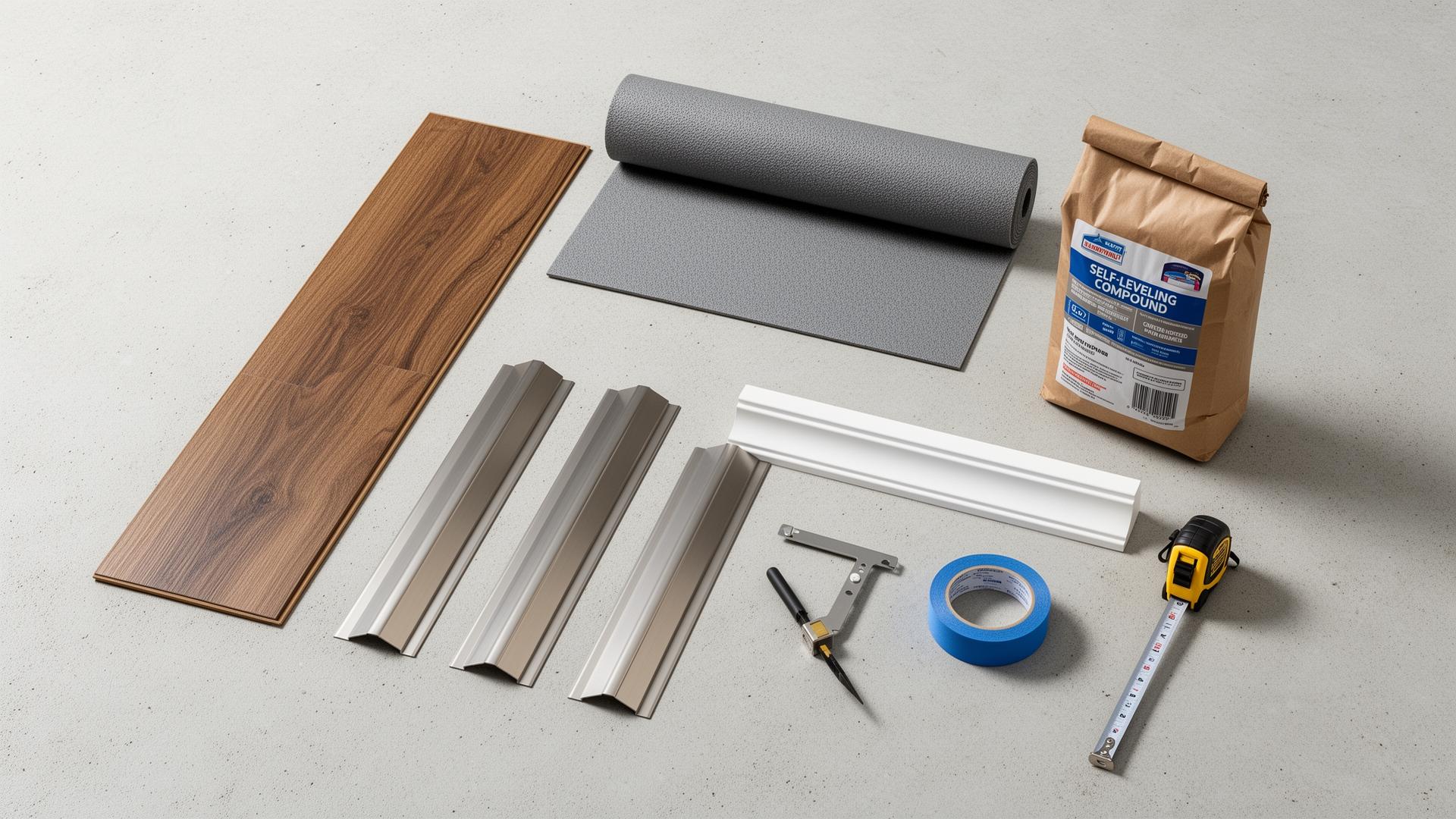
Plan on 10–18% of your material + labor total for supplies on top of the headline price. For a typical 800 sq ft LVP job, that’s usually $400–$1,200 in items like underlayment, transitions, baseboards, leveling compound, and disposal. The exact number depends on how flat your subfloor is, how many doorways the floor crosses, and whether you’re replacing baseboards.
Why supplies are usually a surprise
Most flooring quotes lead with one big number: “LVP installation, 800 sq ft, $X.” What that line item rarely includes is underlayment, transition strips, baseboards or quarter round, subfloor leveling, and disposal of the old floor. Those costs are real, they’re predictable, and they hit your wallet either as a change order partway through the job or as a Home Depot trip you didn’t plan for.
The fix is simple: get an itemized quote, and budget the supplies before you sign. Here’s what each line actually costs.
The supplies, line by line
Underlayment
Required under most click-lock floating LVP unless the plank has underlayment pre-attached (check the spec sheet). Glue-down LVP doesn’t use any.
- Standard foam: $0.20–$0.40/sq ft
- Premium IXPE, cork, or sound-rated: $0.50–$0.90/sq ft
Going premium matters most in condos with HOA sound requirements and over concrete slabs. More on this in choosing the right underlayment for LVP.
Vapor / moisture barrier
Required over concrete slabs. Budget $0.10–$0.25/sq ft, or skip the separate roll and buy a combo underlayment with the barrier already built in.
Transition strips
T-moldings, reducers, end caps, and stair nose pieces — one at every doorway, room transition, and stair edge.
- Doorway transition: $15–$45 each
- Stair nose: $40–$90 per step edge
Most homes need 4–8 transitions. Walk your floor plan and count doorways before you order.
Baseboards or quarter round
LVP needs a 1/4″ expansion gap at every wall. Something has to cover it.
- New baseboards (material + paint): $1.50–$4.00/linear foot
- Quarter round / shoe molding (added to existing baseboards): $0.80–$2.00/linear foot
Quarter round is the budget-friendly path — you keep your baseboards and just cap the gap.
Adhesive (glue-down only)
For glue-down LVP: $35–$80 per 4-gallon pail, covering ~200 sq ft per pail. Click-lock floors skip this entirely. See click-lock vs glue-down for which one fits your room.
Leveling compound / patch
If your subfloor isn’t flat within 3/16″ over 10 feet, you’ll need self-leveler before the planks go down. A 50 lb bag runs $25–$45 and covers about 25 sq ft at 1/4″ depth. Most jobs need 1–3 bags. Why subfloor prep matters explains why skipping this guarantees lippage.
Disposal of old flooring
Dump fees: $80–$200 depending on what you’re tearing out. Carpet and pad fill a dumpster fast; ceramic tile is heavy and gets weighed. Confirm whether the installer hauls it or you arrange a bagster.
Delivery and waste factor
Order 7–10% extra material to cover cuts, defects, and future repairs. Bump to 15% for diagonal layouts or rooms with lots of cuts (jogs, peninsulas, multiple doorways). That extra material is purchased, not free — factor it into your plank budget.
Miscellaneous consumables
Tapping block, spacers, replacement blades, painter’s tape, shoe covers. A pro folds these into overhead. DIY budget: $40–$80.
What’s usually included vs. add-on
Reputable contractors quote labor plus most consumables (blades, tapping blocks, spacers). What’s typically not included by default:
- Underlayment — you choose the grade
- Transitions — you pick the finish to match
- Baseboards / quarter round — homeowner preference
- Disposal — depends on volume of old flooring
- Leveling compound — depends on what the subfloor needs
Before you sign anything, ask line by line: is this in your quote or not?

A realistic example: 800 sq ft of LVP
Here’s how the math works out on a typical Southern California single-room install. Numbers are illustrative — your final quote uses live rates from our pricing page.
| Line item | Calculation | Cost |
|---|---|---|
| LVP planks | $3.50/sf × 880 sf (10% waste) | $3,080 |
| Installation labor | See live rates | — |
| Underlayment | $0.35/sf × 880 sf | $308 |
| Transitions (6) | $30 each | $180 |
| Quarter round | 200 lf × $1.50/lf | $300 |
| Self-leveler (2 bags) | $35/bag | $70 |
| Disposal of old flooring | Single dump load | $140 |
| Delivery | — | $75 |
| Supplies subtotal | ~$1,073 |
That puts supplies at roughly 12% of the total job cost on a clean install. Add 5–6% if you’re replacing baseboards or your subfloor needs serious leveling.
How to keep the supplies budget tight
- Keep existing baseboards and use quarter round to cap the expansion gap. Saves hundreds in material and labor.
- Match underlayment to your subfloor. Premium IXPE over slab; basic foam over plywood. Don’t overpay for sound rating you don’t need.
- Order transitions in one shipment. One trip, one delivery fee, matching dye lot on finish.
- Get a real subfloor assessment first. Two bags of self-leveler is normal; ten bags means you have a bigger problem than supplies.
- Don’t over-order planks. 7–10% waste is standard. 15% only if you have diagonal layouts or many cuts.
What our quotes include
TRU itemizes labor on our pricing page so you see exactly what each step costs. We list supplies separately on every quote — you choose the grade of underlayment, transitions, and baseboards from samples we bring, and you see the price before you commit. No surprise change orders.
If you’d rather start with a real number for your floor, book a measurement or run the calculator on the home page.
Related reading
Know your flooring cost in 60 seconds.
Use our published rates to get an itemized estimate — no phone calls, no sales pressure.